이전 코드 : https://uj07096.tistory.com/65
[My IT : Codes] U-Net 활용 Sementic Segmentation : Football Dataset(1) (시작~ 모델링)
목표: U-Net을 이용해 축구 경기 영상 내의 다양한 객체(예: 골대, 심판, 선수, 관중 등)를 픽셀 단위로 분할하는 Semantic Segmentation 작업을 수행 파이프라인1. 데이터 불러오기 2. 데이터 EDA 3. 데이터
uj07096.tistory.com
5. 하이퍼파라미터 튜닝
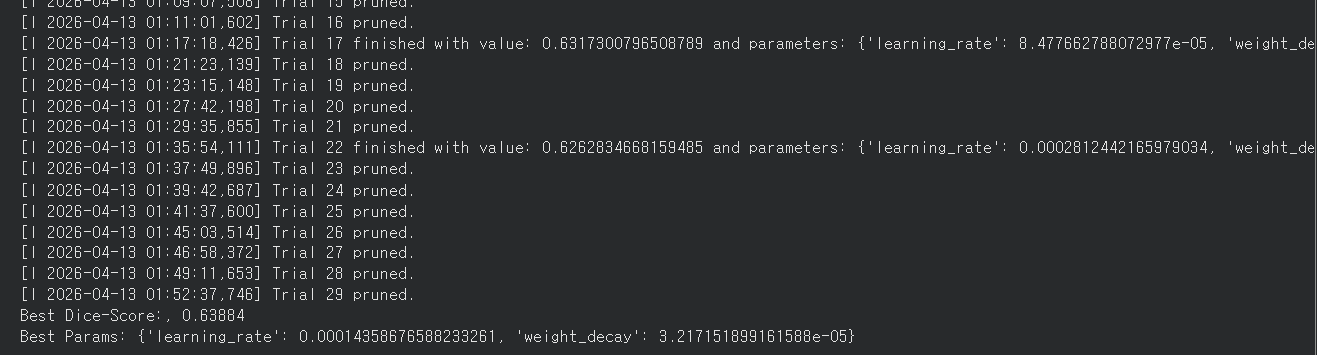
모든 모델에 대해 하이퍼파라미터 튜닝을 진행하면 좋겠지만, 시간 효율성상 가장 빠르게 구동이 가능한 Custom U-Net으로 하이퍼파라미터 튜닝을 진행 후, 같은 하이퍼 파라미터로 다른 모델들의 학습도 진행하기로 하였다.
#optuna 활용 하이퍼파라미터 튜닝
def objective(trial) :
  learning_rate = trial.suggest_float('learning_rate', 1e-5, 1e-1, log = True)
  weight_decay = trial.suggest_float('weight_decay', 1e-5, 1e-2, log = True)

  #모델 할당
  model = UNet().to(device)

  #optimizer(AdamW) 설정
  optimizer = torch.optim.AdamW(model.parameters(), lr = learning_rate, weight_decay = weight_decay)

  #손실함수 설정
  criterion_focal = FocalLoss(gamma=2.0) #focal loss
  criterion_dice = DiceLoss() # 앞서 정의한 DiceLoss 클래스

  #튜닝 기준 지표
  dice = DiceScore(num_classes = 11, input_format = 'mixed').to(device)

  best_dice = 0.0
  epochs = 20

  #튜닝 시작
  for epoch in range(epochs) :
    model.train()
    for batch_idx, (images, masks) in enumerate(train_loader):
      images = images.to(device)
      masks = masks.to(device)

      #forward
      outputs = model(images)

      loss_focal = criterion_focal(outputs, masks)
      loss_dice = criterion_dice(outputs, masks)
      # loss 계산(스케일이 크게 다른 경우를 대비해 0.5해서 합침)
      loss = 0.5 * loss_focal + 0.5 * loss_dice

      #backward
      optimizer.zero_grad()
      loss.backward()
      optimizer.step()

    model.eval()
    dice.reset()
    with torch.no_grad():
      for images, masks in val_loader :
        images = images.to(device)
        masks = masks.to(device)

        outputs = model(images)

        dice.update(outputs, masks)

    dice_score = dice.compute().item()

    #best dice score 갱신시
    if dice_score > best_dice :
      best_dice = dice_score

    #pruning 추
    trial.report(dice_score, epoch)

    if trial.should_prune() :
      raise optuna.exceptions.TrialPruned()
  return best_dice


study = optuna.create_study(direction = 'maximize',
                            pruner = optuna.pruners.MedianPruner(n_startup_trials = 5,
                                                                 n_warmup_steps = 5))
study.optimize(objective, n_trials = 30)

print(f'Best Dice-Score:, {study.best_value:.5f}')
print('Best Params:', study.best_params)
6. 모델 학습/ 결과 시각화
6-1. 반복 함수 정의
총 3개의 모델을 학습하기 위해, 반복적으로 호출할 작업들을 함수로 정의하였다.
- train_test : 모델 학습 및 평가지표 dict에 저장 함수
- plot_history : train_loss와 val_loss의 그래프 시각화, dice score과 miou의 시각화
- draw_res : best model을 가져와 validation 데이터셋의 원본 이미지, 라벨 이미지, 예측 이미지를 시각화
#모델 학습 함수
def train_test(model, model_name, epochs, lr, wd) :
  model = model.to(device)

  #optimizer(AdamW) 설정
  optimizer = torch.optim.AdamW(model.parameters(), lr = lr, weight_decay = wd)

  #스케줄러 설정
  scheduler = torch.optim.lr_scheduler.ReduceLROnPlateau(
    optimizer, mode='max', patience=5, factor=0.5
)

  #손실함수 설정
  criterion_focal = FocalLoss(gamma=2.0) #focal loss
  criterion_dice = DiceLoss() # 앞서 정의한 DiceLoss 클래스

  #튜닝 기준 지표
  dice = DiceScore(num_classes = 11, input_format = 'mixed').to(device)
  miou = MeanIoU(num_classes = 11, input_format='mixed').to(device)

  #학습 기록 저장할 dict
  history = {'train_loss': [], 'val_loss' : [], 'val_miou': [], 'val_dice': [], 'time' : 0.0}

  #체크포인트 저장 폴더 생성
  os.makedirs('checkpoints', exist_ok=True)

  best_dice = 0.0
  best_epoch = 0
  stop_patience = 15
  stopping_cnt = 0

  print('학습 시작')
  start_time = time.time()
  for epoch in range(epochs) :
    model.train()
    t_loss = 0
    for batch_idx, (images, masks) in enumerate(train_loader):
      images = images.to(device)
      masks = masks.to(device)

      #forward
      outputs = model(images)

      loss_focal = criterion_focal(outputs, masks)
      loss_dice = criterion_dice(outputs, masks)
      # loss 계산(스케일이 크게 다른 경우를 대비해 0.5해서 합침)
      loss = 0.5 * loss_focal + 0.5 * loss_dice

      #backward
      optimizer.zero_grad()
      loss.backward()
      optimizer.step()

      t_loss += loss.item()
      if (batch_idx + 1) % 4 == 0: print('.', end='')

    avg_t_loss = t_loss / len(train_loader)
    history['train_loss'].append(avg_t_loss)

    #Validation
    model.eval()
    dice.reset()
    miou.reset()
    v_loss = 0
    with torch.no_grad():
      for images, masks in val_loader :
        images = images.to(device)
        masks = masks.to(device)

        outputs = model(images)

        # loss 계산
        loss_focal = criterion_focal(outputs, masks)
        loss_dice = criterion_dice(outputs, masks)
        loss = 0.5 * loss_focal + 0.5 * loss_dice

        #평가지표 계산
        v_loss += loss.item()
        dice.update(outputs, masks)
        miou.update(outputs, masks)

    avg_v_loss = v_loss / len(val_loader)
    dice_score = dice.compute().item()
    miou_score = miou.compute().item()
    history['val_loss'].append(avg_v_loss)
    history['val_dice'].append(dice_score)
    history['val_miou'].append(miou_score)

    if (epoch + 1) % 5 == 0 :
      print(f"Epoch [{epoch+1}/{epochs}]")
      print(f"Train Loss: {avg_t_loss:.4f}")
      print(f"Val Dice: {dice_score:.4f}, MIoU : {miou_score:.4f}")

    scheduler.step(dice_score)
    if dice_score > best_dice :
      best_dice = dice_score
      best_epoch = epoch + 1
      torch.save(model.state_dict(), f'checkpoints/{model_name}_best_model.pt')
      print(f"Best 모델 갱신 (Epoch {best_epoch}, Dice Score : {best_dice:.6f})")
      stopping_cnt = 0 #stopping count 리셋

    else :
      stopping_cnt += 1
      if stopping_cnt >= stop_patience :  #Early Stopping
        print(f"Early Stopping (Epoch {epoch + 1})")
        break

  end_time = time.time()
  history['time'] = end_time - start_time

  print('학습 종료')
  print(f'모델 : {model_name}, 소요시간 : {end_time - start_time: .5f} (sec)')
  print(f"최적 Dice Score 에포크: {best_epoch}, 최고 Dice 스코어: {best_dice:.6f}")
  return history
loss 그래프의 경우, 1 ~ 20 epoch는 loss값이 커서 뒤쪽에서 과적합 여부를 확인하기 어려우므로 20 epoch 이후부터 그래프를 그렸다. miou와 dice score의 경우 1 epoch부터 관찰했다.
#history 시각화 함수 정의
def plot_history(history) :
  start = 20
  epochs_range_loss = range(start, len(history['train_loss']) + 1)
  epochs_range_score = range(1, len(history['val_miou']) + 1)  # ax2용

  plt.figure(figsize=(8, 8))

  # 학습&평가 손실 시각화
  ax1 = plt.subplot(2, 1, 1)
  # ax1 - 20 epoch 이후
  ax1.plot(epochs_range_loss, history['train_loss'][start-1:], label='train_loss')
  ax1.plot(epochs_range_loss, history['val_loss'][start-1:], label='val_loss')

  ax1.set_title('Training vs Val Loss')
  ax1.set_xlabel('Epochs')
  ax1.set_ylabel('Loss')
  ax1.legend()

  # 정확도&F1 지표 시각화
  ax2 = plt.subplot(2, 1, 2)
  # ax2 - 1부터 전체
  ax2.plot(epochs_range_score, history['val_miou'], label='val_miou')
  ax2.plot(epochs_range_score, history['val_dice'], label='val_dice')
  ax2.set_title('Validation Dice Score & Miou')
  ax2.set_xlabel('Epochs')
  ax2.set_ylabel('Score')
  ax2.legend()


  plt.legend()
  plt.tight_layout()
  plt.show()
# 예측 시각화 함수 정의
def draw_res(model, model_name, n = 5):
    #해당 best 모델 로드
    model = model
    model.load_state_dict(torch.load(f'checkpoints/{model_name}_best_model.pt'))
    model.to(device)
    model.eval()

    #왼쪽 : 오리지널 이미지, 가운데, : 예측 이미지, 오른쪽 : 라벨 이미지
    fig, axes = plt.subplots(n, 3, figsize=(15, n * 4))
    axes[0][0].set_title('Original Image', fontsize=12)
    axes[0][1].set_title('Prediction', fontsize=12)
    axes[0][2].set_title('Label Mask', fontsize=12)

    cnt = 0
    with torch.no_grad():
        for images, masks in val_loader:
            images = images.to(device)
            outputs = model(images)
            preds = torch.argmax(outputs, dim=1).cpu()  # (B, H, W)

            for i in range(images.size(0)):
                if cnt >= n:
                    break

                # 원본 이미지
                img = images[i].cpu().permute(1, 2, 0).numpy()
                img = np.clip(img, 0, 1)
                axes[cnt][0].imshow(img)
                axes[cnt][0].axis('off')

                # 예측 마스크
                pred_color = index_to_color(preds[i].numpy())
                axes[cnt][1].imshow(pred_color)
                axes[cnt][1].axis('off')

                # 정답 마스크
                label_color = index_to_color(masks[i].numpy())
                axes[cnt][2].imshow(label_color)
                axes[cnt][2].axis('off')

                cnt += 1

            if cnt >= n:
                break

    plt.tight_layout()
    plt.show()
6-2. Custom U-Net
모델 시각화
model = UNet().to(device)
summary(model, input_size=(1, 3, 512, 512), depth=1)  # depth로 깊이 조절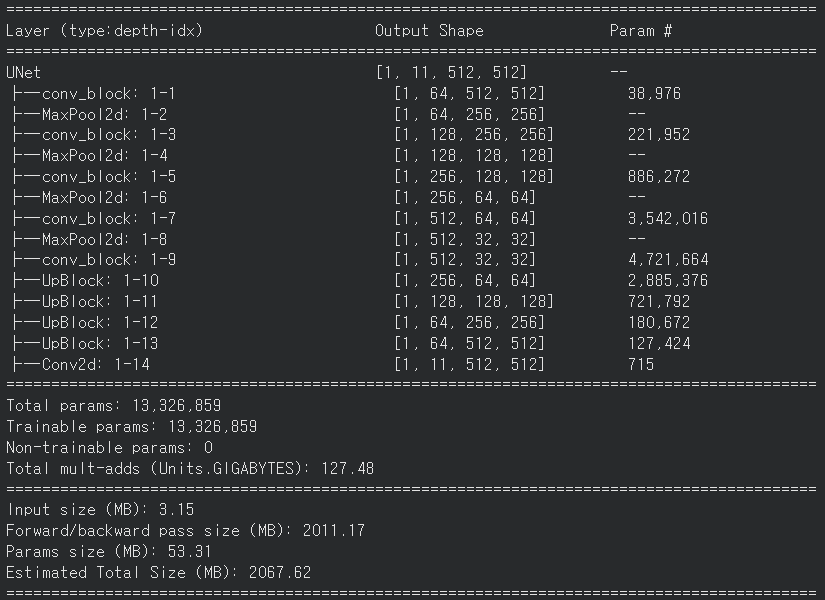
모델 학습 / 그래프 시각화
#튜닝에서 얻은 wd와 lr 로드, 모델 설정
wd = study.best_params['weight_decay']
lr = study.best_params['learning_rate']
epochs = 150

model_name = 'Unet'

#모델 학습
Unet_history = train_test(model, model_name, epochs = epochs, lr = lr, wd = wd)

plot_history(Unet_history)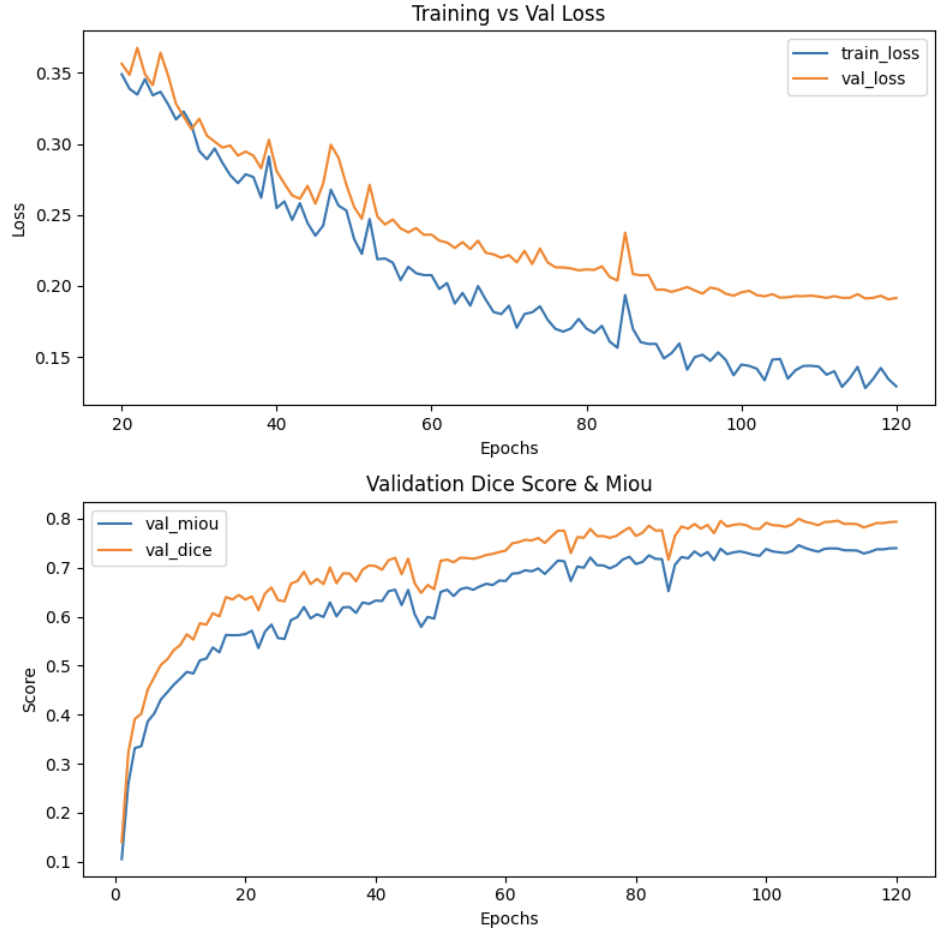
예측 결과 시각화

6-3. ResNet BackBone(Untrained)
모델 시각화
model = UNetResNet34().to(device)

summary(model, input_size=(1, 3, 512, 512), depth=1)  # depth로 깊이 조절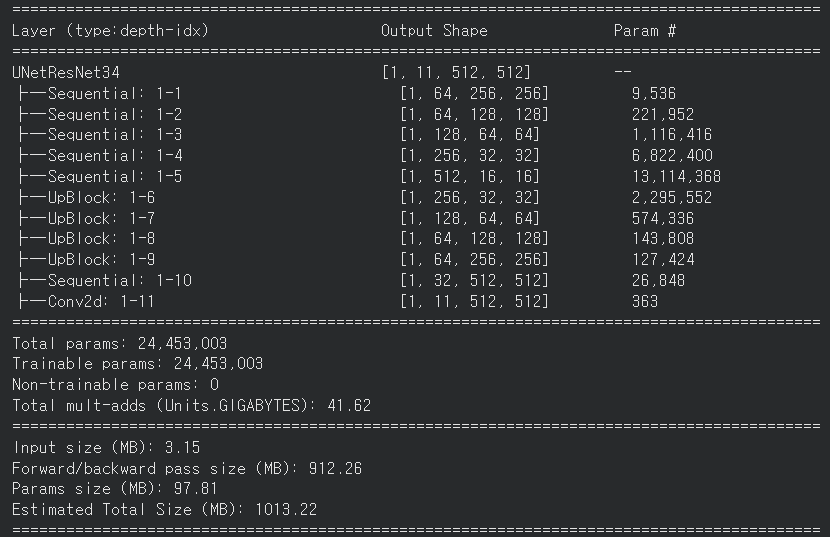
모델 학습/ 그래프 시각화
model_name = 'Unet_ResNet_Untrained'

#모델 학습
Unet_ResNet_Untrained_history = train_test(model, model_name, epochs = epochs, lr = lr, wd = wd)
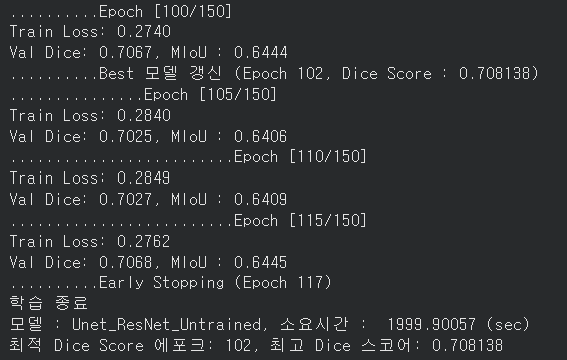
plot_history(Unet_ResNet_Untrained_history)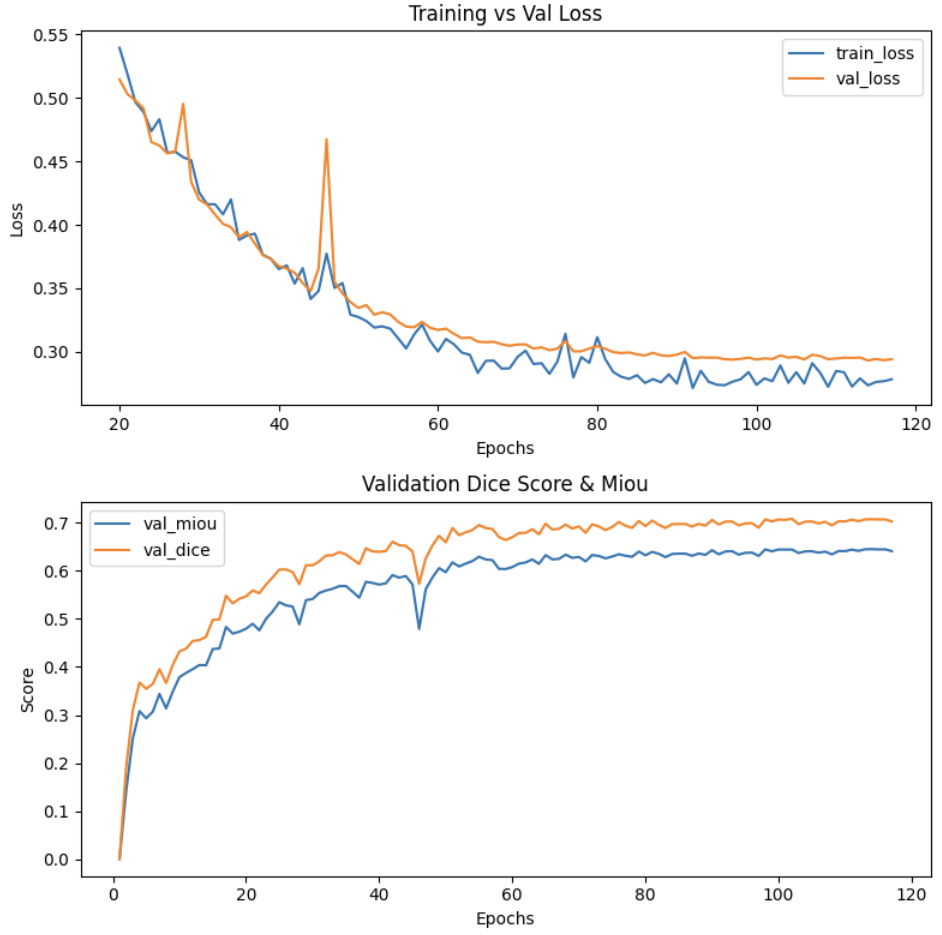
예측 결과 시각화
draw_res(model, model_name)
6-4. ResNet BackBone(PreTrained)
모델의 아키텍처는 UNetResNet34()와 같고, 사전학습 여부만 다르므로 시각화 결과는 6-3과 같다.
모델 학습 / 그래프 시각화
model = UNetResNet34(weights = ResNet34_Weights.IMAGENET1K_V1)
model_name = 'Unet_ResNet_PreTrained'

#모델 학습
Unet_ResNet_Pretrained_history = train_test(model, model_name, epochs = epochs, lr = lr, wd = wd)
plot_history(Unet_ResNet_Pretrained_history)
예측 결과 시각화
draw_res(model, model_name)
7. 성능지표 비교 / 결론
Dice Score이 가장 높았던 시점의 모델들(best_model.pt)의 당시의 성능지표를 DataFrame으로 생성해 표를 만들어 관찰하고, 시각화하였다.
DataFrame 시각화
all_history = {
    'Unet' : Unet_history,
    'Unet_ResNet_Untrained' : Unet_ResNet_Untrained_history,
    'Unet_ResNet_PreTrained' : Unet_ResNet_Pretrained_history
}

rows = []
for model_name, h in all_history.items():
    best_epoch = h['val_dice'].index(max(h['val_dice']))  # best dice score 찍은 에폭
    rows.append({
        'model': model_name,
        'best_dice': round(max(h['val_dice']), 4),
        'best_miou': round(h['val_miou'][best_epoch], 4),
        'train_loss': round(h['train_loss'][best_epoch], 4),
        'time (s)': round(h['time'], 1)
    })

df_result = pd.DataFrame(rows).set_index('model')
df_result
막대그래프 시각화
fig, axes = plt.subplots(2, 2, figsize=(12, 10))
fig.suptitle('Model Comparison', fontsize = 20)

metrics = ['train_loss', 'time (s)', 'best_dice', 'best_miou']
titles = ['Train_Loss', 'Time (s)', 'Best Dice Score', 'Best Miou']
colors = ['steelblue', 'seagreen', 'tomato', 'mediumpurple']
formats = ['.4f', '.1f', '.4f', '.4f']


for ax, metric, title, color, fmt in zip(axes.flatten(), metrics, titles, colors, formats):
    bars = ax.bar(df_result.index, df_result[metric], color=color, alpha=0.8)
    ax.set_title(title, fontsize=13)
    ax.set_xticks(range(len(df_result.index)))
    ax.set_xticklabels(df_result.index, rotation=45, ha='right')
    ax.set_yscale('log')  #값 차이를 명확히 보기 위해서 logscale

    for bar, val in zip(bars, df_result[metric]):
        ax.text(bar.get_x() + bar.get_width()/2,
                bar.get_height() + 0.001,
                f'{val:{fmt}}',
                ha='center', va='bottom', fontsize=9)

plt.tight_layout()
plt.show()

8. 결론
backbone 유무 효과 비교
직접 구현한 U-Net 아키텍처가, BackBone을 Resnet으로 교체한 모델보다 시간이 훨씬 오래걸렸다. 왜 그랬을까 ?
-> ResNet 자체가 Pytorch 내부적으로 최적화가 잘 되어있고, 그때문에 같은 연산량이라도 더 빠르게 돌아간다.
UNet enc1: (B, 64, 512, 512) ← 512 해상도에서 conv(풀링 X)
ResNet enc1: (B, 64, 256, 256) ← 바로 256으로 줄여버림
또한 이렇게 ResNet은 초반에 해상도를 확 줄여서 고해상도에서의 연산 자체가 적다.
사전학습된 weight 효과 비교
사전학습된 가중치를 가져왔을 때, 학습 시간 자체도 훨씬 빠르게 끝나고 정확도도 높게 나왔으며, 육안으로 예측 결과를 봤을 때에도 우수한 성능을 보였다. 왜 그랬을까 ?
아키텍처만 가지고 오고 사전학습된 weights가 없는 모델 : 114 epoch에서 수렴
사전학습된 weights를 가져온 모델 : 97 epoch에서 수렴
사전학습된 weights를 가져오게 되면, 처음부터 의미있는 features를 뽑기 때문에 빠르게 수렴하게 되고, 사전학습 되지 않은 모델을 가져오게 되면 가중치가 random이기 때문에 처음부터 feature 추출까지 진행을 해야한다. 따라서 더 적은 epochs으로도(적은 시간) 좋은 성능에 도달할 수 있었다.
Full code : Github
-> Sementic_Segmentation_Football_Dataset.ipynb
Deep_Learning_prac/Sementic_Segmentation_Football_Dataset.ipynb at main · jaeheonki/Deep_Learning_prac
My Deep Learning practice . Contribute to jaeheonki/Deep_Learning_prac development by creating an account on GitHub.
github.com